
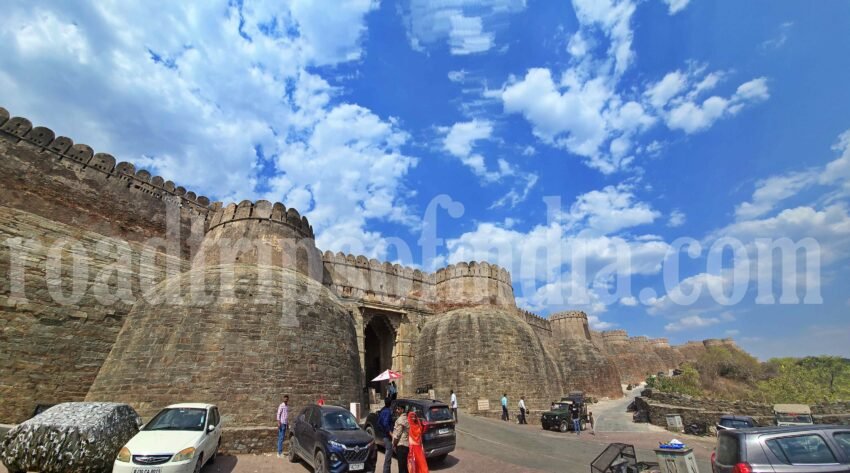
Discover Rajasthan’s legendary Kumbhalgarh Fort with this full guide. Discover its history, the reasons it’s worth seeing, the exact location of the Kumbhalgarh fort, the ideal time to visit, highlights, views, travel advice, and frequently asked questions to help you plan your trip.
Introduction
The First Glimpse of Kumbhalgarh
There are places you should visit because everyone says you should, and some places you discover almost by accident. Kumbhalgarh Fort was that second kind for me. I had seen a few photos on Instagram long stone walls curling over hills, views that looked almost unreal but nothing prepared me for how the fort actually feels when you see it rising from the Aravalli mountains.

I still remember the journey toward Kumbhalgarh Fort. The landscape slowly changed from city edges to thick forest, and the air shifted too cooler, slightly scented with dry leaves and stone. Meanwhile, the fort kept appearing and disappearing behind the hills, almost teasing the traveler approaching it. I found myself leaning forward in the car, trying to spot the walls again, like a child waiting to see a surprise.
When Curiosity Turns Into Admiration
If you’ve ever looked at something from far away and thought, “Okay, that seems big,” only to get closer and realize it is massive, you’ll understand what happened next. The closer we drove, the more the walls stretched and unfolded. Photos make the fort look impressive; in reality, it feels almost impossible — as if someone stitched a fortress onto the mountains with threads of stone.
I wasn’t even planning to spend more than a couple of hours here. But something about the place — maybe the silence, or the height, or the sense of age started pulling me in before I even reached the gate.
A Fort That Doesn’t Try to Impress You — It Already Does
Unlike other forts in Rajasthan that showcase grand palaces and ornate rooms, Kumbhalgarh has a different personality. It’s rugged, raw and honest. The beauty here is not in decoration but in scale, strength, and survival. It’s the kind of place where you don’t need a guidebook to feel the importance of what you’re seeing; the stones themselves tell you.
Why This Blog Exists

After exploring it, walking across its courtyards, touching its rough walls, and looking at the hills that stretch endlessly around it, I knew I didn’t want to write a boring, mechanical guide. I wanted to write the kind of guide I personally search for — a mix of story, practicality, emotions, and facts. A guide that helps you imagine the journey before you even take it.
So here it is — your complete Kumbhalgarh Fort travel guide, with everything you need to know and everything I felt along the way.
Why Visit Kumbhalgarh Fort?
The Wall That Leaves You Speechless
You’ve probably heard this already:
Kumbhalgarh Fort has the second-longest continuous wall in the world, right after the Great Wall of China.

But hearing that and seeing it are very different things.
The wall doesn’t just go around the fort — it bends, rises, splits, and wraps around the mountains like a protective snake. In fact, in some parts, it’s so wide that eight horses could ride together. While walking on it, you feel both tiny and powerful at the same time. The world below extends far beyond what your eyes can catch, and yet the stones beneath your feet feel strong and grounded.
A View That Gives You Perspective
Every time you climb another section of the fort — and you will be climbing a lot — the view rewards you. The Aravalli hills seem endless. Villages look like tiny dots. The forest looks untouched, almost ancient.
And that height… it does something to your mood. It clears it, maybe. Or resets it. I stood near one of the bastions for a long moment just watching shadows move across the hills. Meanwhile, the wind kept messing up my hair, but I didn’t care.
A Fort That Lets You Breathe
Some historical places feel crowded even when they’re empty. Not this one. Kumbhalgarh Fort gives you space — actual physical space and that mental kind of space where you can hear your own thoughts. The courtyards are wide. The pathways spread across the mountain. Visitors scatter naturally, and conversations stay soft.
It’s a fort built for defense, but today, it feels like a fort built for reflection.
A Deep Connection Between Nature and Architecture

This fort isn’t just on a hill; it is part of the hill. The way the walls hug the mountain, the way the steps follow natural slopes, the way the towers blend into the rock — it all feels intentional. On the other hand, the wildlife sanctuary around it adds another layer of beauty. Sometimes you hear birds. Sometimes you hear rustling in the bushes. The fort doesn’t fight nature; it grows out of it.
History and Important Facts About Kumbhalgarh
Built by a Visionary: Maharana Kumbha
The fort was constructed in the 15th century by Maharana Kumbha, one of the greatest kings of Mewar. He built 32 forts in his lifetime, but Kumbhalgarh was his crown jewel — the fort that defined his legacy.
Birthplace of Maharana Pratap
This alone gives the fort emotional significance. Maharana Pratap, the iconic Rajput warrior known for his courage, was born here. It’s strange how knowing this changes your experience. Suddenly the courtyards don’t feel empty — you imagine a child running across them, unaware of the legend he would become.
A Fort That Never Fell in Direct Battle
One of the most fascinating facts is that the fort was never conquered by direct assault.
It fell only once, and that too because enemies cut the water supply. The fort, however, reclaimed itself soon after.
Strength, endurance, and strategy are built into its stones.
360+ Temples Inside
Yes, the fort houses over 360 temples, both Hindu and Jain. Some are large and placed prominently. Others are tucked away behind walls, half-hidden but still serene. Walking through them feels like walking through layers of devotion left behind by centuries.

Badal Mahal — The Palace in the Clouds
Perched at the highest point of the fort is Badal Mahal, meaning “Cloud Palace.” The name fits perfectly. The rooms are painted in soft pastel tones, and when the wind enters the windows, it almost feels like the palace is breathing.
Exploring Kumbhalgarh Fort
The Entrance: Ram Pol
Walking through Ram Pol feels like entering a story. The gate is tall, narrow, and designed to confuse enemy elephants. The stone pathway curves slightly, forcing you to walk slowly. Meanwhile, the temperature changes too — stone absorbs coolness, making the air feel softer.

The Ascent
The fort doesn’t reveal everything at once. Each turn shows you something new — a temple, a bastion, a sudden opening where the view jumps out at you. The path upward is steady, not too hard, but you’ll feel your legs warming up. However, every step feels worth the effort.
The Wall Walk
If you do only one thing at Kumbhalgarh, walk on the wall. Even a short walk gives you a sense of how vast the fort is. The stones are uneven in places, but the feeling of standing so high, surrounded by uninterrupted landscape, is unforgettable.
Reaching Badal Mahal
Finally, when you reach Badal Mahal, the fort’s highest point, the wind greets you like an old friend. The views from up there feel like Rajasthan opened itself just for you. I don’t think I spoke for a few minutes; the moment demanded silence.
Architecture of Kumbhalgarh
Strength Over Ornamentation
If you’re expecting delicate carvings and luxury, you might be surprised. Kumbhalgarh’s beauty lies in its rawness. The architecture prioritizes defense — thick walls, angled gateways, strategic towers, and wide-open courtyards.
Harmony With the Hills
The fort blends so naturally with the mountains that it feels like it grew there. Builders used local stone, and almost every structure follows the natural contour of the hills.
Temples Throughout
Because of the number of temples inside, the fort feels spiritually alive. Even if you’re not deeply religious, the architecture of these temples — simple yet powerful — leaves a mark.

How to Reach the Kumbhalgarh Fort Location
Distance
Kumbhalgarh is around 85 km from Udaipur — perfect for a day trip. First reach udaipur , you can find the details in blogpost : How to Reach Udaipur , then we booked cab you can check below options.
Best Travel Options
Cab or taxi, Self-drive car, Motorcycle trip, Limited Rajasthan tourism buses
Best Time to Visit
Winter (Oct–Feb) — best weather, Monsoon (Jul–Sep) — dramatic clouds and greenery, Summer mornings — manageable but hot afternoons
Duration Needed
Most visitors take 2–3 hours inside the fort.
Tips for Visiting
Wear comfortable shoes
Carry water
Don’t rush — the fort deserves time
Start early for fewer crowds
Explore at least a part of the wall
Don’t skip Badal Mahal
Keep snacks — food options are limited
If traveling in monsoon, expect mist and slippery stones
Map Pin
📍 Kumbhalgarh Fort, Kumbhalgarh, Rajasthan 313325

FAQs
What is Kumbhalgarh Fort famous for?
It’s famous for its massive 36 km wall, its unbeaten military history, and being the birthplace of Maharana Pratap.
Where is Kumbhalgarh Fort located?
It is located in the Aravalli hills of Rajasthan, about 85 km from Udaipur.
Who built Kumbhalgarh Fort?
It was built by Maharana Kumbha in the 15th century.
Is Kumbhalgarh worth visiting?
Definitely. The views, the heritage, and the atmosphere make it one of Rajasthan’s most memorable forts.
How long does it take to explore?
Plan for at least 2–3 hours to enjoy the full experience.
Final Thoughts
Kumbhalgarh Fort isn’t a place you “see.” It’s a place you feel — in your legs as you climb, in your breath as the wind hits your face, in your thoughts as you look across the endless hills.

It teaches you something quietly: strength doesn’t always roar. Sometimes it stands silently on a hill, wrapped in stone and history.
If Rajasthan is a tapestry of emotions and stories, then Kumbhalgarh Fort is one of its strongest threads — steady, resilient, unforgettable.
You should also visit Monsoon Palace in Udaipur checkout our post: https://roadtripsofindia.com/monsoon-palace-udaipur-a-complete-guide-to-sajjangarh-palace/
To know us more follow us on instagram: roadtripsofindia




[…] Udaipur and nearby places, you may also like our detailed travel guides on Monsoon Palace, Kumbhalgarh Fort, and Chittorgarh Fort for history, timings, maps, and travel […]