Edupayala Temple in Telangana sits where three rivers meet. This travel blog shares our experiences, trekking paths, parking tips, monkeys, and what to expect.
Introduction
The road to Edupayala Temple doesn’t feel like a typical temple drive. There are no big boards shouting directions. The landscape changes slowly. Fields stretch on both sides, and small villages come and go without noise.
When I finally got down from the bus, I didn’t hear traffic. That silence surprised me. Somewhere nearby, I could hear water flowing, but I wasn’t sure from where. I stood there for a moment, unsure which direction to walk. Nobody rushed me. Nobody tried to sell anything. There was just a simple road leading toward the river.
That first pause stayed with me through the entire visit. Edupayala Temple doesn’t call you loudly. It waits. And in that waiting, you start leaving behind the noise you carried with you.
Why Edupayala Temple Is Worth Visiting
Some temples impress you with gold, towers, or crowds. Edupayala Temple does something else. It impresses you by slowing you down.
Even if you don’t know the full story, you feel something different when you stand there. Water moves quietly, and people behave gently. Nobody pushes you to hurry.
Another reason this place feels special is the journey. You don’t feel like a tourist here. You feel like someone who took a small turn away from the city and found peace by accident.
And then there’s the walk. Not just one, but many. Each path leads you deeper into calm. You start with the main temple, then move upward, and then even further, until you reach places that don’t feel touched by time.

History or Background
People here say Edupayala means seven streams. Edu means seven and Payalu means streams. When I first heard this, honestly I didn’t care much. Only after I walked near river I start feeling it is really special place.
Seven small streams come here and mix with Manjeera river. You may not see clearly all seven, but local people know where each water coming from. One uncle was telling story to me in broken Telugu, smiling, saying this water is not normal water, it is blessing.
There is old story also. They say Maharaja Parikshit, grandson of Arjuna, was doing some big puja to remove curse. During that time blood of snakes fell in seven places and later that place became seven streams. I am not fully sure how true it is, but everyone here believe it strongly.
During Shivaratri, this place become full crowded. People put tents everywhere. River flows strong in rainy season and sometimes water comes till goddess feet. Standing there, watching water, I felt this place is more than just temple. It is feeling, not story.
Architecture and What Makes It Special
Edupayala Temple is simple. You won’t find tall towers or heavy carvings here. The structure feels like it belongs to the land.
The Shiva Lingam is placed close to the riverbank. You are never far from flowing water. Stone floors, basic pillars, and open areas create a feeling of space rather than formality.
What makes the temple special is its location. The building doesn’t dominate the rivers. It listens to them.
Step-by-Step Visitor Experience
Parking and First Steps
When you reach Edupayala Temple, don’t look for a proper parking area. There is no dedicated parking space. Most people park their vehicles along the roadside. It can feel messy, so reaching early helps.
Dealing With Monkeys
As soon as you get down, you’ll notice many monkeys around. They love coconuts and prasad. Keep your bags closed, and don’t carry food openly.

Main Temple Visit
Before entering, you need to leave your footwear outside. There are small counters where you can keep your slippers or shoes for ₹10 per pair. It feels simple and organised.
Inside, the temple is calm. People offer prayers quietly. There is no entry fee at all.
Trek to the Hill Temple
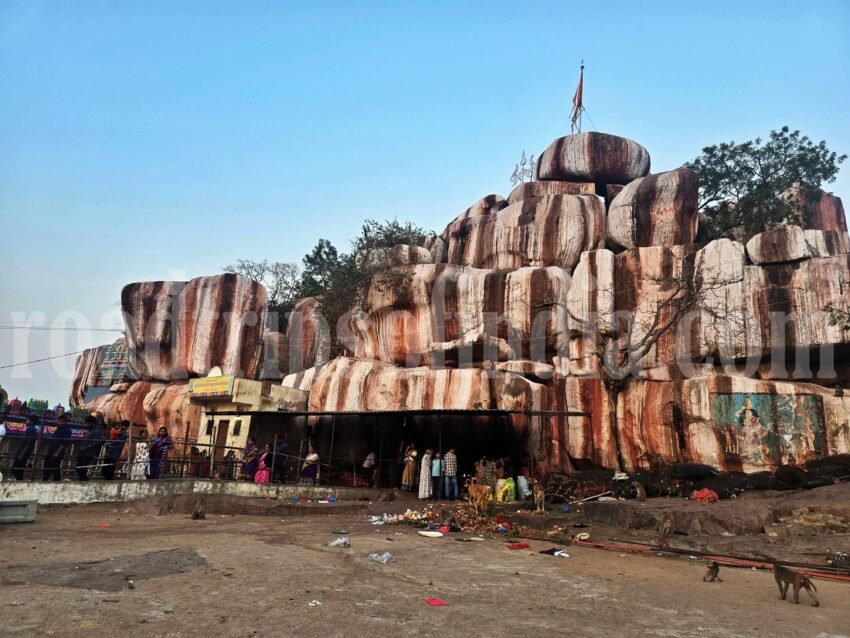
After the main temple, there is another temple located higher up on the hill. You have to walk — it’s not just stairs, it feels like light trekking. The path is uneven, but the walk feels refreshing.

Walk to the Muni Den
If you continue further beyond the hill temple, the trail doesn’t stop. There is more trekking, and it leads to a quiet place known as the Muni Den, where a saint is believed to have meditated. The walk is longer and tiring, but the silence there feels worth every step.

Waterfall Spot and Photos
Near the temple area, there is a small waterfall-like stream. People stand there taking pictures. It’s not huge, but it adds beauty.

You will also find local photographers sitting with cameras. You can ask them to take your family photos. They give hard copies and soft copies, which many families enjoy.
Phone Rules and Shopping
They say mobile phones are not allowed inside the temple. However, I did see a few people quietly using them. Still, it’s better to respect the rule.
Outside, you will find many small stalls selling flowers, coconuts, toys, snacks, and pooja items. It feels like a small village market.
Things People Usually Miss
Most visitors come, pray, and leave. They miss the slow walks, the extra paths, the quiet corners, miss how the air changes as you walk higher, how the river sounds different at each bend.
They miss sitting still.
Best Time to Visit
Season
October to February is the best time. The weather stays cool, and the rivers look peaceful. Monsoon months are beautiful too, but the paths can get slippery.
Time of Day
Early morning is perfect. The air feels fresh, and the temple feels truly calm.
Timings and Tickets
Edupayala Temple opens early morning and stays open till evening.
There is no entry fee.
Footwear deposit costs ₹10 per pair.
How to Reach
By Air
Hyderabad Airport is the nearest. From there, taxis or buses go toward Medak district.
By Train
The nearest major station is Medak or Hyderabad. Local transport connects you further.
By Road
Edupayala Temple is about 80 km from Hyderabad. Buses and taxis are easily available.

Nearby Places
After visiting Edupayala Temple, you can explore Medak Church or simply spend time by the Manjeera river.
Map Location
Google Maps Pin https://maps.app.goo.gl/EszCprZwXFfNQaRM8. The route is clear, and most drivers know the place.
Frequently Asked Questions
How much time should I keep for visiting Edupayala Temple?
Most visitors spend about one to one and a half hours here. If you plan to walk up to the hill temple and the Muni Den, keep at least three hours.
Is the trekking path difficult?
The paths are uneven and a bit tiring, but not dangerous. Take it slow, wear good footwear, and rest in between if needed.
Are there food options nearby?
You will find small stalls selling snacks, coconuts, tea, and water. There are no big restaurants, so eat something light before coming.
Is Edupayala Temple crowded on weekends?
Weekends and festival days are busier. If you prefer quiet time, try to visit on a weekday morning.
Conclusion
Edupayala Temple doesn’t feel like a place you rush through. It feels like a place that asks you to stay, even if only for a little while.
I remember sitting near the river after finishing the long walk to the Muni Den. My legs were tired, my phone was in my bag, and for once, I didn’t feel the need to check it. The sound of water, the slow movement of people, and the quiet prayers in the background felt enough.
There was no pressure to buy anything, no voice telling me to move ahead. Everyone seemed to be in their own small moment, connected only by the place.
That is what makes Edupayala special for me. It isn’t about perfect rituals or big temples. It’s about finding space to breathe in a world that rarely slows down. And when you finally leave, you don’t feel like you are going away from something. You feel like you are carrying a little of that calm back with you.
If you’re looking for another peaceful place just a 2–3 hour drive away, don’t miss our detailed travel guide on Bidar https://roadtripsofindia.com/bidar-fort-architecturehistory-and-travel-guide-all-you-need-to-know/.
To know us more follow us on instagram: roadtripsofindia